
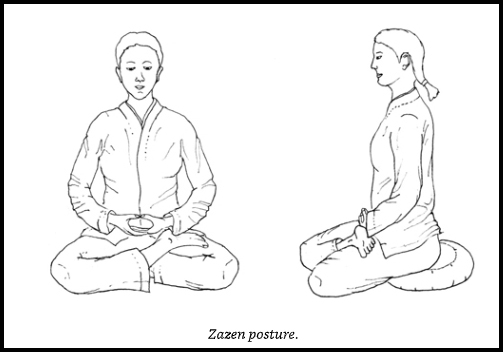
I want to begin with an episode in the history of Buddhism that is particularly important in the development of Zen. The event is referred to in early Buddhist texts as The Flower Sermon.
In this famous story, Gotama Buddha is surrounded by a large gathering of students waiting expectantly for him to deliver a sermon. They hope to hear more words of wisdom and advice. Instead, Gotama says nothing, but raises a lotus flower in the fingers of one hand. The students are bewildered. Gotama’s silence goes against what they expect from a teacher, and they become restless and deeply puzzled. We might think of this silent holding of the flower as perhaps the first Zen koan. As the silence grows longer the students are given the opportunity to really attend to what is happening, to sit with their preconceptions and to realise how deeply they are enmeshed in habits of expectation and preconceived ideas about learning. They are offered an opportunity to realise that it might be helpful to let go of such attachments and delusions, and to simply be present to Gotama, to his hand and to the lotus flower.
As it happens, only one student, Mahākāśyapa, seems to realise what Gotama is doing, and he smiles. Gotama interprets the single fleeting smile as a manifestation of Mahākāśyapa’s intuitive realisation of his teachings. Gotama then reminds his students that his teachings are not dependent on words or letters – he is not teaching an academic discipline or a theory, instead he is showing them how to be mindful and how to cope with the trials and tribulations of everyday life. Mahākāśyapa seems to have realised that Gotama is asking him to let go of his preconceptions and his ideas about what makes a good teacher and to encounter the flower as it is, in all its ineffable beauty, vivacity and sheer presence. This marks a shift in Mahākāśyapa’s relationship with his experience – a letting go, or stepping back from, reactive habits of thought and behaviour. Needless to say, Gotama entrusts to Mahākāśyapa the task of transmitting his teachings to others – he becomes Gotama’s successor. This transmission of understanding through action and showing, rather than through words, becomes a founding principle of Zen Buddhism.
According to Zen interpretations of Gotama Buddha’s teaching, one of our key tasks in tackling suffering is to change our relationship to our experiences – not by talking, analysing and theorising, but by ‘silent illumination’ – the power of sitting in silence and letting go of words, theories and abstractions – just being present to what is. By freeing ourselves from mental, mostly verbal, entanglements – often driven by habit, and by the belief that the ‘answer’ to life’s difficulties is by intellectual effort and analysis – we can change our relationship with our experiences and not be overwhelmed or disturbed by what is going on.
Many of life’s difficulties and modes of suffering are the result of cravings for permanence and clinging to what is always passing – that is, our difficulty in dealing with impermanence and change. This underlying problem can often be reinforced and exacerbated by verbal thinking. Verbalising itself can be a powerful mode of clinging and craving – the very habits we are trying to release ourselves from. Patterns of attachment, desire and delusion can often be reinforced by the way we think about them and verbalise our thoughts. While talking can undoubtedly solve many problems and help us to get through difficulties by sharing experiences, it may often be part of the problem and prolong the difficulty. At a very fundamental level we may need to learn how to let go of the mental chatter in order to reset our relationship with words, theories and habitual patterns of thought. This release from mental and verbal entanglements is part of what Gotama advocates as an effective way of alleviating suffering. Hence the great emphasis he placed on silent meditation as a practical method for engaging with difficulties and suffering in life.
Gotama advises us to be careful that we don’t become too attached to words or advice – or to the teachers who give advice. It is zazen/mindful meditation that is the teacher. What is needed is a fundamental transformation of attitude and belief in how we learn – which is often by unlearning, by letting go and paying attention to what is going on. This huge shift from an over-reliance on talk, texts and analysis, is indicated quite clearly in the following well-known sayings: ‘Those who know do not speak; Those who speak do not know’ (from Lao-tzu – often quoted by Zen teachers). These words ascribed to Bodhidharma: ‘A special transmission outside the scriptures, Not depending on words and letters; Directly pointing to the mind; Seeing into one’s true nature and realising Buddhahood.’ And these lines from Tilopa’s famous text, the Six Nails or Precepts: ‘No thought, no reflection, no analysis, no cultivation, no intention; let it settle itself.’
It may be that this fundamental shift or transformation – from over-reliance on words and texts, to realisation through practical experience – is what distinguishes Buddhism, particularly Zen, from much of Western philosophy and psychology. In this deep sense, zazen/mindful meditation is not a tool to be used in the abstract realm of words and theories, it is a way to live or a way of being-here in this world. This may be why Gotama Buddha, and Zen teachers through the ages, have emphasised that zazen is an end in itself – not a means to an end.
When we sit in mindful meditation, we learn to set aside our learning, opinions and habits of thought and feeling, in order to see clearly into our own nature – what is often referred to as our ‘Buddha nature’ – that is, experiencing at first hand the transience and deep connectedness of all phenomena. There is no tradition of ‘guided meditations’ in the Soto Zen tradition. I provide the same old guided meditation only because many people find it useful – but it can easily become a trigger for internal commentaries and wordy reflections that can take us away from being-here, being awake and present.
Here is my variation on a poem by the Zen teacher, Ryokan:
Reworking Ryokan
the past is already past
the future is not yet here
the present never abides
things are ever-changing
there’s nothing on which to depend
let go of names and words
let go of time-worn views
don’t chase after ideas
sit quiet and reflect on how things are
let the world and its beauty
flow on
To paraphrase the Japanese Zen teacher, Kodo Sawaki: ‘All Buddhist writings and theory are a footnote to the practice of zazen.’ (Uchiyama & Okumura 2014: 28)
References
Uchiyama, Kosho & Okumura, Shohaku. 2014. The Zen Teachings of Homeless Kodo. Boston: Wisdom Publications.