
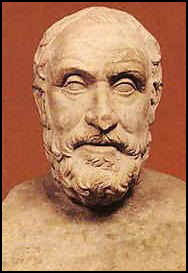
In this talk I am going to offer a few thoughts on what we might call a ‘sceptical approach to Zen Buddhism – that is, a worldview rooted in the ideas and practices of both Zen Buddhism and the sceptical philosophy established by the ancient Greek thinker, Pyrrho of Elis – who lived from around 360 – 270 BCE. As far as we know Pyrrho produced no writings and what we understand of his life and ideas comes to us via the writings of Sextus Empiricus who lived in the mid to late 2nd Century CE and Diogenes Laertius, who lived in the 3rd Century. These two writers drew their information from fragments of texts by Timon of Phlius, who had been a student of Pyrrho’s.
In many ways the label ‘sceptical Zen Buddhist’ describes my position more accurately than ‘secular Buddhist.’ ‘Mindful sceptic’ may be even more apt.
The word ‘scepticism’ is derived from the Greek term, skepticos, which refers to someone who endlessly investigates, someone who goes in for skeptesthai, or enquiry – so a sceptic is an investigator who is always open to new knowledge and ready to revise their opinions. The sceptic in this sense does not have, or seek, dogmatic belief and fixed knowledge. The sceptic realises that all things change, and all entities only exist in an infinite field of relationships. The Buddhist parallel to sceptical enquiry can be clearly seen in the practice of zazen or mindfulmeditation – that is, a clear-sighted awareness of moment-by-moment consciousness, a non-judgmental and non-reactive observation of experience as it happens. There is no end to the enquiry and no bed-rock or fixed essence to be found underlying our fluid consciousness. The investigator, whether Buddhist or sceptic, or both, finds equilibrium, understanding and compassion through the process of investigation, through clear-sighted dispassionate observation – coming to terms with the complex dynamics of life as it lived, not as it is imagined, idealised or wished to be. The mindful meditator is constantly awakening, growing in understanding and developing as a living being.
As far as we can tell the Buddha, like Pyrrho, urged his students not to blindly accept everything he said. Unthinking attachment to a teacher, or to an abstract idea or belief – however eminent or celebrated the teacher might be – was a hindrance to liberation and insight. Any teachings need to be tested within the laboratory of everyday life, tested by each individual to ascertain how effective they may be. The insight meditation teacher, Joseph Goldstein, quotes the Buddha as saying: ‘Don’t believe anyone. Don’t believe me. Don’t believe the teachers. Don’t believe books or traditions. Rather, look to your own experience. In that way we become our own refuge, not dependent upon any external authority or system.’ (in Walker 1987: 640) Without questioning and testing against one’s own experience any teaching can become a dogma to be unthinkingly followed and any teacher can become a dictator to be submissively obeyed.
Pyrrho is reputed to have been a painter before he became a philosopher or investigator. He is also thought to have accompanied Alexander on his expedition to north-west India in 327 BCE and may well have conversed with Indian philosophers and teachers from different traditions – including Brahmins, Buddhists and Jains. There seems to be very persuasive evidence that a cross-fertilisation of ideas and practices was happening at this time and what we know of sceptical thought from this period has affinities with aspects of Indian practical philosophy, and vice versa. It is important to remember that philosophy at this time, in both cultures, was seen as a practical attempt to develop effective ways of living a good life rather than as a purely intellectual or academic endeavour.
As I got to know more about sceptical ideas in western philosophy, I found a recurring thread of positive doubt, a celebration of uncertainty and a tolerance for all viewpoints, this seemed to echo what I was finding out about Daoism and Zen Buddhism, and it appeared to be at odds with the usual idea that what we should seek is certainty, absolute truth and one coherent solid view of the world. These sceptical ideas of multiple viewpoints, beliefs and ways of picturing the world also seemed closer to what the arts were concerned with – giving voice to many viewpoints, picturing the world from many perspectives – none of which is right or final. This does not mean that the sceptic doesn’t have opinions or beliefs but only that he or she doesn’t consider them as absolute or universally valid – they are as sceptical of their own views as they are of the views of others. Holding lightly to any view is wise. Listening carefully to other views is also wise.
Another point of similarity between Buddhism and Pyrrho’s scepticism is in their thinking about the relatedness of everything. We are enmeshed in our surroundings, implicated in the world, interdependent with everything we are supposedly not! Our breathing in and out is, practically and symbolically, an affirmation of relatedness. We exist in a relational universe. We are unable to exist in a vacuum or in isolation from our surroundings. No entity has a fixed essence or existence independent from everything else – all entities are empty of self-existence. This interdependence and interrelatedness is what Buddhists refer to as sunyata – often translated as ‘emptiness’. The indefiniteness of boundaries is what ancient Greek sceptics refer to as aoristia. Within both of these traditions, relatedness and boundary-lessness are fundamental conditions of existence. To believe, and act on the belief, that we are separate from the world, or from other beings, is to be deluded.
There are endless ways of picturing an apple just as there are endless ways of thinking about ourselves and the world. Wisdom grows by trying to take account of as many perspectives as possible – always being open to the possibility that there is more to be discovered. Sceptical enquiry, like Buddhist awakening, is a process that is never complete. Although they are now cliches, terms like ‘don’t-know mind’ and ‘beginner’s mind’ still convey a sense of how Pyrrho and Zen teachers encourage us to approach life – open rather than closed, always ready to revise what we think and believe in the light of each fresh experience.
_________________________________________________________________________________
In case you are interested, Pyrrho’s approach to life and his embrace of positive uncertainty, can be seen as having similarities to the thinking of a number of later sceptical writers, for instance: the wonderful French essayist, Michel de Montaigne (1533-92), the Scottish enlightenment philosopher, David Hume (1711-76), and the twentieth-century American Pragmatists, John Dewey, William James, C.S.Peirce and Richard Rorty. There are also parallels with the writings of Zen teachers, for instance: the thirteenth-century Japanese master, Eihei Dogen, and the twentieth-century Japanese teachers, Kosho Uchiyama, and Shunryu Suzuki – who coined the phrase ‘beginner’s mind,’ and the Korean teacher, Seung Sahn – who writes about ‘don’t-know mind.’ These Zen teachers seem to me to epitomise what it is to be a mindful sceptic.
BIBLIOGRAPHY
Danvers, John. 2012. Agents of uncertainty: mysticism, scepticism, Buddhism, art & poetry. Amsterdam: Rodopi.
Empiricus, Sextus. 1990. Outlines of Pyrrhonism. New York: Prometheus Books.
McEvilley, Thomas. 2002. The Shape of Ancient Thought: Comparative Studies in Greek and Indian Philosophies. New York: Allworth Press/School of Visual Arts.
Walker, Susan, ed. 1987. Speaking of Silence: Christians and Buddhists on the Contemplative Way. New Jersey: Paulist Press. Joseph Goldstein is quoting his own version of an extract from the Anguttara-nikaya.