
I am sure I have mentioned many times that my practice of Zen meditation, zazen, began in 1965 when I came across a short text by Dogen in a book on Buddhism that I found in my local library. It may well have been the only book on Buddhism in the library, and it must have had a short section on Zen. I had become interested in Zen through reading the ‘beat’ writers Jack Kerouac, Allen Ginsberg, and my favourite, the poet, Gary Snyder. Reading some of Snyder’s accounts of how he had, for a time, studied Zen meditation in a monastery in Japan, sparked my interest – but I had found very little information about how to actually do Zen meditation. So, it was fortuitous that I should come across Dogen’s brief set of guidelines for a form of meditation that seemed to me to be pared back to something simple and practical. Looking back after all these years to a time when there was no Internet and no social media, I realise what an amazing stroke of luck it was that I stumbled across this text in a provincial library in middle-England. This lucky event had a profound and lasting influence on my life.
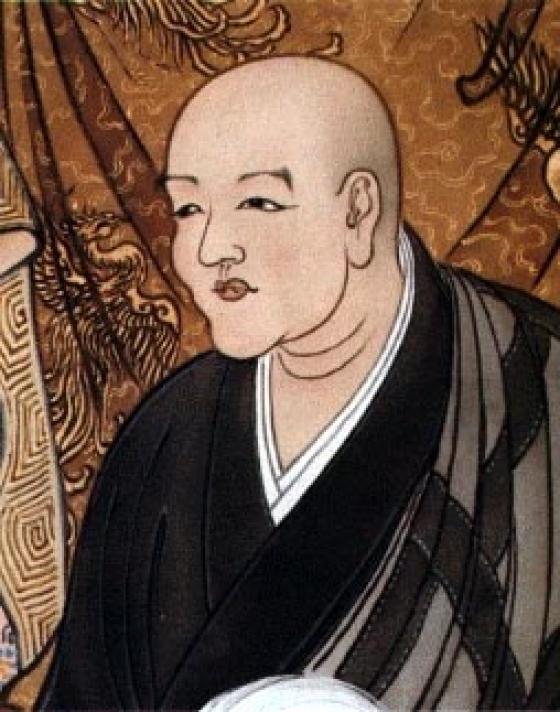
The Japanese Zen teacher, Eihei Dogen, was born in 1200 and died in 1253. He has been enormously influential on the development of Zen in Japan, particularly on the Soto School. In his essay, probably written in 1227, shortly after he returned from studying in China, Dogen provides a concise, yet detailed, description of how to practice zazen (sitting meditation). Most of the essay is concerned with posture, the correct way to sit – but keep in mind that for Dogen body and mind are not separate entities, they are two facets of one entity. It is also useful to note that for Dogen the embodied mind of a person is not separate from other beings or things – all minds are porous, interdependent and ever-changing, and can be considered as facets of an infinitely-faceted field of consciousness.
There are many English-language translations of the Fukanzazengi and they vary enormously in language, style and clarity. This condensed version is based on seven different translations – listed below. I have tried to produce a version that is fluent, coherent and useful, conveying as far as I am able the main points of Dogen’s sometimes enigmatic text. Any errors, or misleading guidance, are mine, and should not be blamed on any of my sources.
GUIDANCE FOR THE PRACTICE OF ZAZEN – though there are many varied translations of the title, this version seems to me to be a useful and simple indicator of what the text is intended to be.
The Way, the Dharma, Buddha-nature, is completely present when you are completely present. Practice the Way and realise your Buddha-nature.
Zazen practice is not based on intellectual understanding, or the pursuit of words and speech. Learn instead the art of contemplation – looking within and shining a light on the nature of ‘self.’ When you practice zazen your egocentric awareness of body and mind will drop away, and your original face or Buddha-nature will be realised. There is no ladder of progress or attainment in zazen. If you want to attain suchness and awakening, you should practice suchness and awakening now as you sit in zazen. The practice of zazen is the practice of awakening.
Keep in mind that the ancient sages were diligent in their practice. Even Shakyamuni Buddha had to sit in zazen for six years, and Bodhidharma sat in meditation for nine years facing a wall.
For zazen, it is helpful to sit in a quiet room. Eat and drink moderately. Let go of attachments, wants, judgments and opinions, including the desire to be enlightened – for these only confuse and disturb the mind. There is no need to discriminate between good or bad, right or wrong. No need to interfere with the workings of the mind or trying to control the movements of your thoughts. Let things be. In this way your Buddha-nature will manifest itself.
With eyes always open, sit up straight, keeping your spine erect. Do not lean to the left or right; do not bend forward or backward. Keep your ears in line with your shoulders, and your nose in line with your navel. With your mouth closed, rest your tongue gently against the roof of your mouth and breathe naturally through your nose. Be relaxed and yet alert.
The hands are held lightly in the lap with the tips of the thumbs just touching each other, and the palms facing up. The left hand is placed over the right. When held in this way, the palms and the thumbs form an oval.
Once you have adjusted your posture and your breathing, sway gently left and right until your body settles in a stable position. Sit like a mountain – neither trying to think nor trying not to think. Just sitting – letting thoughts come and go without interference or attachment. This is the art of zazen.
Every human being is equally imprinted with the Buddha-nature. However, without the practice of zazen, you will not realise your full potential and your true nature will not manifest itself. So, everyone should practice the Way, which is nothing other than understanding the true nature of the Self.
You are endowed with all you need to practice the Way of the Buddha. Our bodies are like dew on the grass. Our lives are like a flash of lightning, gone in an instant, vanished in a moment. So do not waste time.
Remember, when you are sitting wholeheartedly and single-minded in zazen, that in itself is the practice of the Way of the Buddha.
SOURCES
Carl Bielefeld, trans. 2002. Fukanzazengi: Principles of Seated Meditation – in, On Zen Practice: body, breath & mind, by Taizan Maezumi & Bernie Glassman, Wisdom Publications.
Sekkei Harada. 1998. The Essence of Zen. Kodansha International.
Norman Waddell & Abe Masao, trans. 2002. Fukanzazengi: Universal Recommendations for Zazen – in, The Art of Just Sitting, by John Daido Loori, ed. Wisdom Publications.
Dan Welch & Kazuaki Tanahashi, trans. 2002. Zazengi: Rules for Zazen – in, John Daido Loori, ed. The Art of Just Sitting. Wisdom Publications.
Yuho Yokoi. 1976. Zen Master Dogen: an introduction with selected writings. Weatherhill.
Translation courtesy of The Order of Buddhist Contemplatives – a Soto Zen school founded by Jiyu-Kennett in 1970.Online at: http://www.shastaabbey.org/pdf/rules4md.pdf – accessed: 11 April 2021.
Translation courtesy of San Francisco Zen Centre, founded by Shunryu Suzuki (Soto Zen) in 1962. This translation is very similar, and may be based on, that of Norman Waddell and Masao Abe. Online at: https://www.sfzc.org/files/daily_sutras_Fukanzazengi – accessed 11 April 2021.